The Heart of Yoga by Desikachar T.K.V
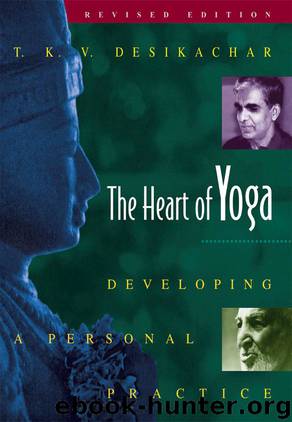
Author:Desikachar, T.K.V [Desikachar, T.K.V]
Language: eng
Format: epub
Tags: Essai, Inde, Yoga, Spiritualité
ISBN: 9781594778926
Publisher: Democrite - Giga
Published: 2010-11-01T13:00:00+00:00
Krishnamacharya in (top to bottom) halāsana, supta koṇāsana, bhujaṅgāsana.
12
The World Exists to Set Us Free
We cannot simply start adhering to the five yamas by practicing ahiṃsā first and, when we have mastered that, proceeding to satya, and so on. Our behavior changes gradually as we progress along the yoga path, a path that is. determined by the desire to better ourselves by any means. In this connection, the word aṅga or “limb” has a very important meaning. From conception through a child’s full development, all the limbs of the fetus grow simultaneously; the body does not sprout an arm first, then a leg, and so on. Similarly, on the path of yoga all eight aspects develop concurrently and in an interrelated way. That is why the Yoga Sūtra uses the term aṅga for the eight limbs of yoga. Patañjali refers to them collectively as aṣṭāṅga.
Pratyāhāra
We have already discussed the first four limbs of yoga: āsana, prāṇāyāma, yama, and niyama. The fifth limb of yoga, pratyāhāra, has to do with our senses.1 The word āhāra means “nourishment”; pratyāhāra translates as “to withdraw oneself from that which nourishes the senses.” What does this mean? It means our senses stop living off the things that stimulate; the senses no longer depend on these stimulants and are not fed by them any more. Our eyes are drawn to a beautiful sunset as bees are drawn to honey—this is the way our senses function normally. But there is also the possibility that the most beautiful sunset on earth will not attract our attention, will not engage our senses, because we are deeply immersed in something else. Normally the senses say to the mind: “Look at this! Smell this! Touch that!” The senses register an object and the mind is drawn to it at once.
In pratyāhāra we sever this link between mind and senses, and the senses withdraw. Each sense perception has a particular quality to which it relates: the eyes relate to the form of something; the ears to the sound, the vibration it makes; the nose to its smell. In pratyāhāra it is as if things are spread out with all their attractions before our senses, but they are ignored; the senses remain unmoved and uninfluenced.
Let me give you an example. When we are totally absorbed in the breath during prāṇāyāma, when we are completely with it, pratyāhāra occurs quite automatically. The mind is so intensely occupied with the breath that all links between mind, senses, and external objects that have nothing to do with the breath are cut. So pratyāhāra is not a state of sleep. The senses are quite capable of responding, but they do not because they have withdrawn.
As another example, when I am asked a question, I try to clarify the subject I have been discussing as I answer. As I become more involved in my response, I grow less aware of where I am. I become increasingly more engrossed in the interaction—this is another manifestation of pratyāhāra. Although I
Download
This site does not store any files on its server. We only index and link to content provided by other sites. Please contact the content providers to delete copyright contents if any and email us, we'll remove relevant links or contents immediately.
Unwinding Anxiety by Judson Brewer(73457)
The Art of Coaching by Elena Aguilar(53678)
The Fast Metabolism Diet Cookbook by Haylie Pomroy(21265)
Rewire Your Anxious Brain by Catherine M. Pittman(18812)
Healthy Aging For Dummies by Brent Agin & Sharon Perkins RN(17128)
Talking to Strangers by Malcolm Gladwell(13562)
The Art of Thinking Clearly by Rolf Dobelli(10724)
Mindhunter: Inside the FBI's Elite Serial Crime Unit by John E. Douglas & Mark Olshaker(9538)
Crazy Rich Asians by Kevin Kwan(9426)
The Compound Effect by Darren Hardy(9169)
Tools of Titans by Timothy Ferriss(8605)
Periodization Training for Sports by Tudor Bompa(8426)
Becoming Supernatural by Dr. Joe Dispenza(8379)
Wonder by R. J. Palacio(8262)
Bodyweight Strength Training by Jay Cardiello(8042)
Crystal Healing for Women by Mariah K. Lyons(8012)
Change Your Questions, Change Your Life by Marilee Adams(7938)
Nudge - Improving Decisions about Health, Wealth, and Happiness by Thaler Sunstein(7864)
Should I Stay or Should I Go? by Ramani Durvasula(7787)
